


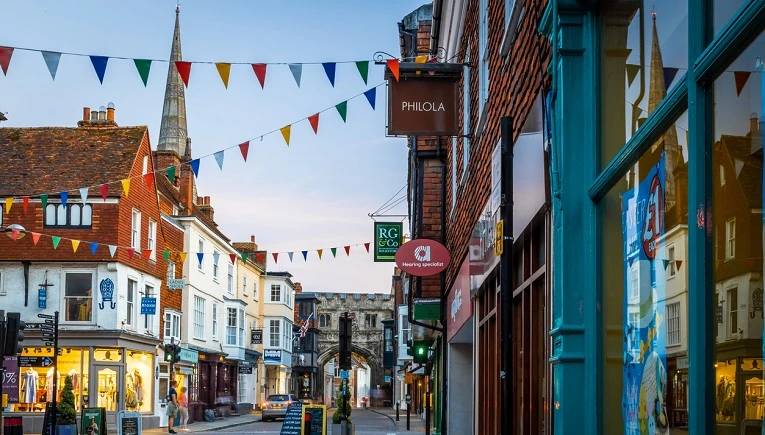
On a damp weekday morning in Manchester, before the office crowd arrives, the shop lights come on one by one along the side streets first, not the main road. A bookseller props open a stubborn wooden door with a crate of paperbacks. A coffee grinder starts up somewhere behind frosted glass. A florist drags buckets onto the pavement and checks the sky with visible suspicion. Independent retail here doesn’t begin with marketing plans or footfall graphs; it begins with unlocking, sweeping, adjusting, repeating.
Manchester’s high street story is often told through closures — shuttered chains, empty units, “To Let” signs that seem permanent. But that version misses something quieter and more stubborn. Independent retailers have not vanished. They have narrowed, specialised, improvised, and, in some cases, outlasted their larger neighbours by refusing to play the same game.
They survive partly by choosing streets the chains don’t want anymore. Walk five minutes off Market Street and the rent drops just enough to make risk tolerable. The Northern Quarter remains the most obvious example, though even there prices have crept upward. Smaller traders now leapfrog further outward — into mixed residential pockets, converted warehouses, and odd corner units with awkward layouts that scare corporate tenants but suit creative ones.
Their advantage is flexibility measured in hours, not quarters.
A record shop owner can turn half a floor into a live set space in a week. A clothing retailer can pivot from vintage denim to repair services when supply tightens. A bakery can cut wholesale and sell out daily by noon, then close rather than overproduce. These are small decisions that would stall in a chain of command but happen quickly when the owner is also the buyer, merchandiser, and cashier.
Margins are protected through specificity. General stores struggle; specialist ones develop loyalists. Manchester independents often narrow their identity until it feels risky — Japanese stationery only, regional craft beer only, salvaged furniture only, queer literature only. The narrower the focus, the stronger the repeat customer pattern. It’s counterintuitive but observable: constraint builds gravity.
Footfall patterns have also changed in their favour, though not evenly. The old model — Saturday rush, weekday lull — has fractured. Hybrid work means Tuesday afternoons can feel like Saturdays in neighbourhood high streets such as Chorlton or Didsbury. Local independents benefit from residents who now shop near home three days a week instead of commuting five. City-centre dependence is no longer the only survival model.
Community has become a business tool, though few owners would call it that. Notice boards are fuller. In-store events are more frequent. Workshops, tastings, readings, repair clinics — these are not gimmicks but traffic engines. An independent shop must justify the trip in ways an online cart never can. Experience is not decoration; it is infrastructure.
There is also a tactical use of online platforms without surrendering to them. Many Manchester independents treat e-commerce as a catalogue rather than a primary sales channel. Click-and-collect works better than shipping for fragile margins. Instagram functions as a shop window more than a checkout lane. Owners post arrivals, not ads. The tone is conversational, almost diary-like, and customers respond to that authenticity because it feels unfiltered.
Some survive by sharing space. Split leases are increasingly common — a wine shop plus a cheese counter, a barber plus a clothing rack, a gallery plus a café. Overheads divide; audiences overlap. It creates hybrid spaces that feel alive even during slow hours. The high street unit becomes less a shop and more a small ecosystem.
I once noticed that the busiest corner of an independent shop is rarely the till — it’s the place where conversations stall and restart.
Manchester’s markets play a role often overlooked in retail analysis. Places like Afflecks and the Arndale Market operate as incubators where low-commitment stalls allow traders to test concepts before taking on full leases. Many successful independents begin there, learning pricing, stock pacing, and customer behaviour face-to-face. Failure is cheaper in a stall. Lessons are immediate.
Landlords, too, have adapted — selectively. Some now prefer independents for longer-term stability, offering stepped rents or turnover-based agreements. Not from generosity, but from vacancy fatigue. An occupied unit that grows slowly is better than a branded tenant that leaves abruptly. This shift is uneven but real enough to matter.
Then there is the matter of trust, which sounds sentimental until you see it function economically. Customers forgive stock gaps, price fluctuations, and shorter hours when they know who runs the place. They return because they feel recognised. Chains invest heavily trying to simulate this through loyalty schemes; independents achieve it accidentally by standing behind the counter.
Manchester shoppers, for their part, show a particular kind of pragmatism. They are price-aware but not purely price-driven. Many will split purchases — essentials online, discretionary items locally. A customer might buy bulk household goods from a major platform and then spend freely on a single well-made object from an independent maker. The psychology is compartmentalised rather than contradictory.
Survival also depends on restraint. The independents that last rarely expand quickly. Second locations are approached cautiously, sometimes reluctantly. Growth is viewed as exposure, not victory. Owners talk more about control than scale. That mindset runs against startup culture but aligns with endurance.
Weather matters more than reports admit. A week of heavy rain can halve walk-in trade. A sunny Saturday can rescue a month. Independents plan cash buffers around forecast patterns, not just quarterly projections. It’s retail in its most literal sense — exposed to the street, dependent on passing feet.
Manchester’s event calendar — festivals, football matches, university terms — creates pulses of opportunity. Smart independents map their stock and staffing to these rhythms. Limited runs appear before big weekends. Extended hours align with concerts. Temporary product lines surface during student move-in periods. Timing is treated as inventory.
There is also a visible emotional cost. Owners talk about exhaustion without dramatics. Many work six days, sometimes seven. Holidays are negotiated with guilt. But there is pride in autonomy that softens the edges of that fatigue. They are not waiting for directives. They are making calls daily, sometimes hourly.
Not all survive, of course. Turnover is constant. For every long-running independent, there are several that lasted only a season. But the ecosystem absorbs this churn. New operators learn from the recently closed. Fixtures get reused. Suppliers get reassigned. Knowledge circulates informally.
The high street, in this version, is not dying — it is decentralising and specialising at the same time. Independent retailers in Manchester are not trying to restore the past model. They are building a narrower, more personal one in its place, shop by shop, decision by decision, morning by morning.