


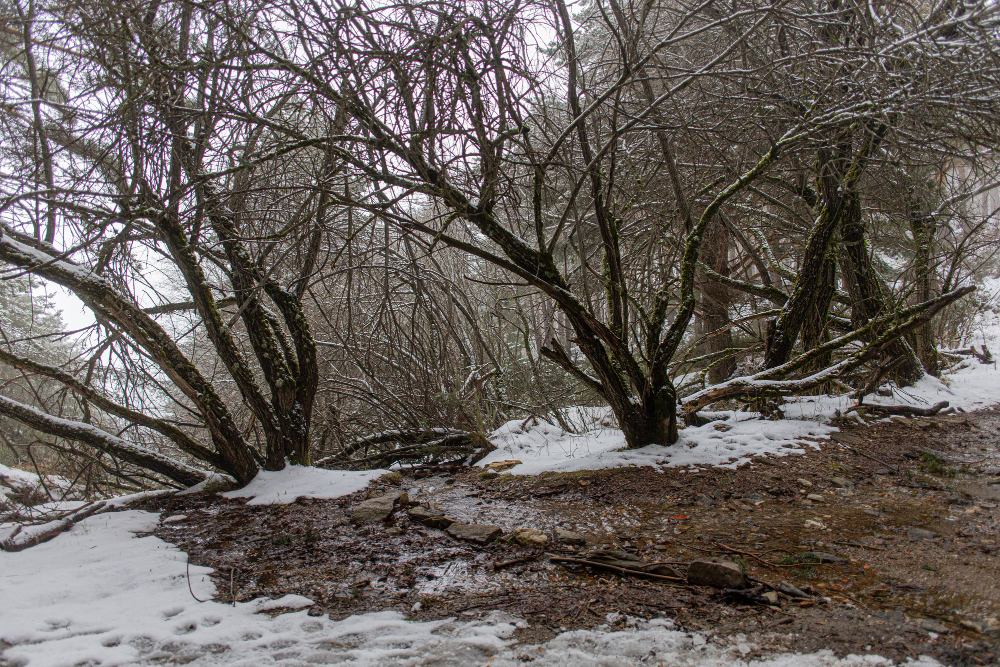
Usually, there is no ceremony when the sound arrives. No caution. No slow build. The street is silent one minute, encased in icy air that seems abnormally heavy, and then a sudden crack pierces the quiet with startling accuracy.
People’s descriptions of it are remarkably similar. A shot. A blowing transformer. A limb breaking in two. These descriptions proliferated in recent days as deep freezes spread over vast areas of North America, swiftly permeating both timelines and neighborhoods.
| Item | Details |
|---|---|
| Common Phrase | Trees exploding from cold |
| Scientific Term | Frost cracks |
| Trigger | Sudden, extreme temperature drops |
| Typical Sound | Sharp crack or gunshot‑like bang |
| Most Affected Trees | Maples, sycamores, lindens |
| Primary Cause | Uneven contraction and freezing sap |
| Structural Risk | Usually low, sometimes moderate |
| Long‑Term Outcome | Often heals, occasionally weakens trunk |
Even though it isn’t exact, the expression “trees exploding from cold” gained popularity because it seems accurate at the time. Trees are not exploding in all directions. Under bark that appears perfectly calm from the outside, they are releasing pressure that has quietly built up as they split inward.
The noise’s mechanism is remarkably good at confusing people.
Sap inside a tree rises higher than normal during brief warm spells, saturating internal tissues with moisture. The outer layers of the trunk cool and contract much more quickly than the inner wood when temperatures drop sharply, causing tension to build up quickly and unevenly.
Sap starts to freeze and expand inside, applying pressure to the wood fibers that are already getting tighter due to the cold. Eventually, the imbalance resolves itself in a sudden fracture, turning the tree into a rigid container containing opposing forces.
The sound that results is not subtle. One crack can travel far from its source because cold air carries noise with noticeably better clarity. The sound feels closer, sharper, and more intimate in the late hours of the night when there is no wind or traffic.
Trees with thin bark are especially at risk. Arborists frequently mention maples, sycamores, and lindens—not because they are weak, but rather because of their structure, which makes it easier for temperature changes to spread out unevenly and more quickly.
The response is usually one of disbelief followed by uneasiness in urban areas where extreme cold is rare. The sound is familiar but no less startling in areas used to severe winters, particularly when it reverberates through residential streets instead of woods.
One winter evening, I recall stopping in mid-step when I heard a crack nearby. I instinctively looked for smoke or movement in the dark before realizing that the street appeared exactly as it had moments before.
One of the things that makes people uneasy is the visual stillness. Even though a frost crack extends for several feet along the inside of a trunk, it may not show any visible symptoms right away. Even though it formed in a single instant, a narrow vertical split that appears days later is frequently misinterpreted as recent damage.
The majority of frost cracks are not lethal. Over time, trees have developed ways to gradually compartmentalize damage, seal wounds, and grow around it. Rather than being a fatal injury, the crack frequently leaves a permanent scar.
Mature trees, which frequently withstand several winters with ancient cracks that never completely go away but infrequently jeopardize stability, benefit greatly from this resilience.
But not every result is harmless. A serious crack can compromise the structural integrity of older trees or those already under stress from disease, drought, or prior damage. Professional evaluation is recommended because branch failure is more likely to occur, particularly close to residences, sidewalks, or roads.
Arborists always stress that the danger is not the sound itself, but rather the consequences of ignoring damage. A cracked tree is a message worth paying attention to, but it is not an emergency.
The word “explode“‘s widespread use speaks more to human perception than to the biology of plants. When faced with sudden, unexplained force, especially when it disrupts routine and safety assumptions, we tend to use dramatic language.
That instinct is accelerated by social media. Context is removed in short videos. A loud sound turns into a danger. Anecdotes become apparent patterns when they are repeated.
However, when frost cracks are viewed calmly, they can be subtly educational. They demonstrate how inflexible systems react to sudden changes and how stress builds up imperceptibly until it must be released.
By dehydrating prior to winter, reducing sap content, and improving flexibility, trees that have adapted to colder climates reduce this risk. Particularly during unpredictable weather patterns, people who are torn between warmth and cold are more likely to voice their objections.
When the temperature stabilizes, the noise itself quickly disappears from memory. Scars are softer with spring growth. The vertical lines carved into the bark are obscured by leaves. Until the next severe cold snap hits, what’s left is frequently forgotten.
However, for a few nights every winter, communities are reminded that quiet is not the same as peace and that even the landscape’s most recognizable elements are reacting, adapting, and occasionally breaking under circumstances that are changing more quickly than they can handle.
The trees aren’t blowing up. They are using the only language that is permitted by the situation.