


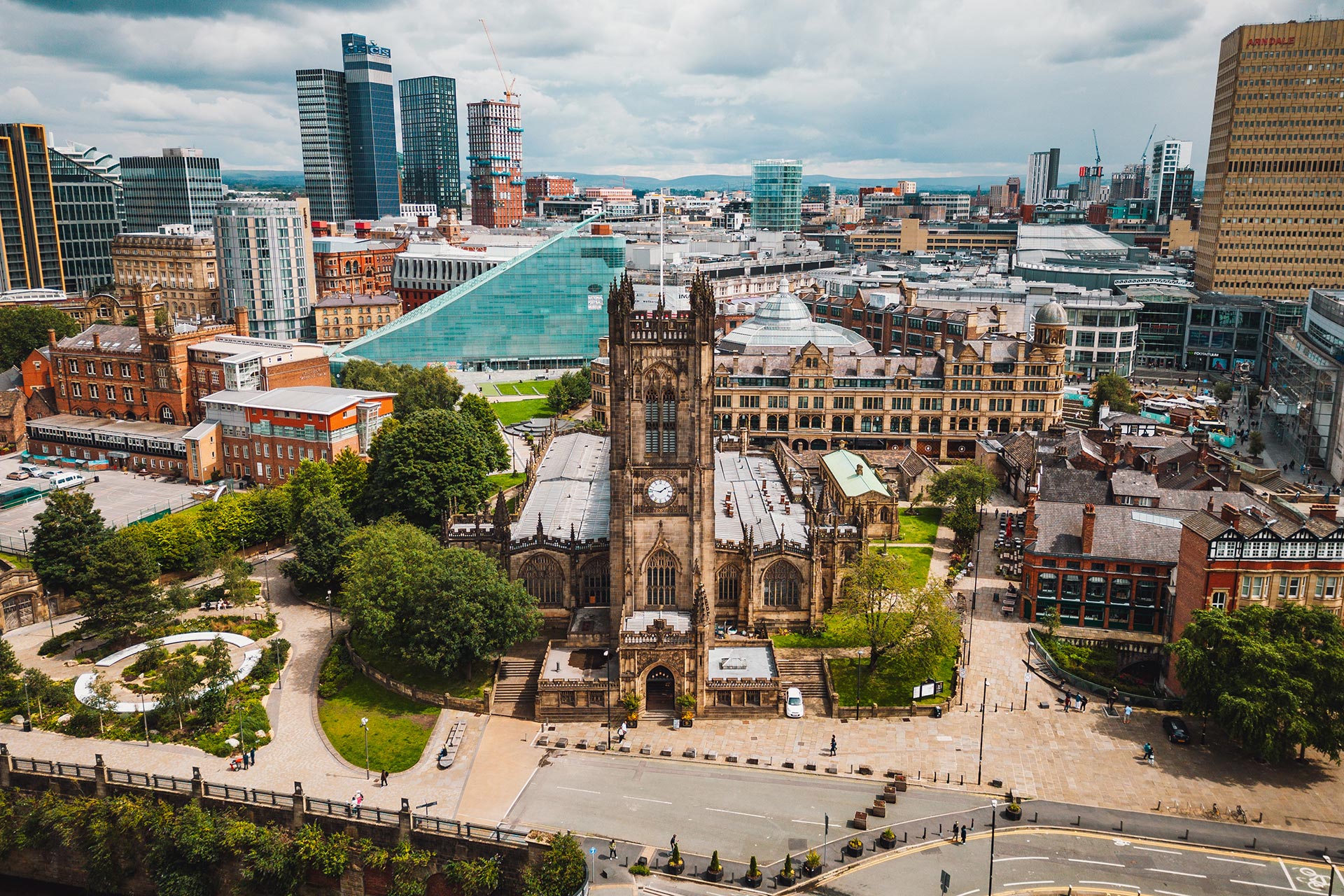
Manchester’s streets hum with a rhythm that feels almost orchestrated. Cranes pivot overhead, scaffolding drapes old façades, and the distant clatter of tools punctuates the chatter of coffee shops. Each new construction site is more than concrete and steel; it is a subtle signal that the city is in motion, constantly recalibrating itself for the economy it hopes to host.
Walk along Deansgate or through the NOMA district, and the effect of recent Manchester developments is immediately tangible. Office towers rise alongside newly opened residential blocks, their mirrored surfaces reflecting the city’s own transformation. It’s not just the structures themselves, but the businesses they attract and the footfall they generate. Startups and established firms alike are drawn to these revitalized precincts, curious to see if their operations can thrive amidst the urban reinvention.
Investors have been watching this city closely. The expansion of Spinningfields, in particular, has become a benchmark project, blending corporate offices with leisure spaces in a way that encourages longer hours spent—and money spent—within the district. I recall speaking with a local café owner who mentioned that foot traffic had doubled in the six months following the completion of a nearby office block. Her voice carried both awe and exhaustion, a reminder that economic growth is often a quiet struggle behind the headlines.
Construction in Manchester has evolved beyond mere quantity. Today, developers prioritize mixed-use schemes that promise flexibility and resilience in the local economy. Buildings are designed not only to accommodate offices or homes, but to host retail, cultural spaces, and public areas, inviting interaction and investment in equal measure. The St John’s development exemplifies this philosophy, weaving old industrial textures with new energy-efficient designs. Observing the progress, I found myself pausing under a half-finished archway, struck by the contrast between past and present.
The job market benefits first and most visibly from these developments. Construction crews, architects, project managers, and supply chains all feel the impact. But the ripples extend further: hospitality, transportation, and even creative industries find renewed purpose as neighborhoods are reimagined. Manchester’s approach illustrates a deliberate attempt to create a virtuous cycle—buildings generate business, business generates employment, employment generates demand for more amenities, and the cycle feeds itself.
Yet, these projects are not without friction. Residents often voice concerns about rising rents or the overshadowing of historical areas. The construction process itself can be messy, unpredictable, and occasionally contentious. The tension between progress and preservation is palpable along the streets of Circle Square, where modern towers stand beside long-established communities. One can feel the city negotiating with itself, attempting to balance economic ambition with cultural memory.
At a roundtable discussion last autumn, a council planner remarked that Manchester developments are “as much social experiments as economic strategies.” The comment lingered with me. It’s rare to hear officials frame construction in this human context, acknowledging that architecture shapes daily life as much as GDP numbers. Each crane and concrete pour is a statement about what the city values, what it hopes to attract, and how it imagines itself in the next decade.
Investment patterns tell their own story. Institutional funds, international buyers, and local entrepreneurs increasingly favor areas of the city with active development pipelines. The logic is straightforward: a vibrant construction scene signals opportunity, but it is also a vote of confidence in Manchester’s long-term prospects. Developers respond in kind, tailoring projects to anticipated economic trends while also experimenting with design features that might appeal to future tenants.
The subtlety of impact is perhaps most apparent in the residential sectors. New apartments near transit hubs or cultural centers see faster occupancy, often commanding premium rents. For the city, these numbers are more than statistics; they signal a demographic shift toward younger, mobile professionals who contribute to the city’s cultural and economic vitality. It’s fascinating to consider that a single development can quietly influence patterns of migration, social life, and commerce.
I remember walking past the completed Circle Square towers just before sunset, watching shadows stretch across the plaza. The hum of life was almost cinematic, yet it struck me how delicate this growth really is—dependent on a mixture of investment, policy, and the unpredictable rhythms of human behavior.
In Manchester, construction is a public performance. It communicates ambition, resilience, and the city’s willingness to reinvent itself. Each project is a dialogue between past and future, between heritage and economic pragmatism. And while financial analysts will debate ROI and occupancy rates, the lived experience of the city—the cafés that open, the streets that feel busier, the skyline that shifts—is where the real story unfolds.