


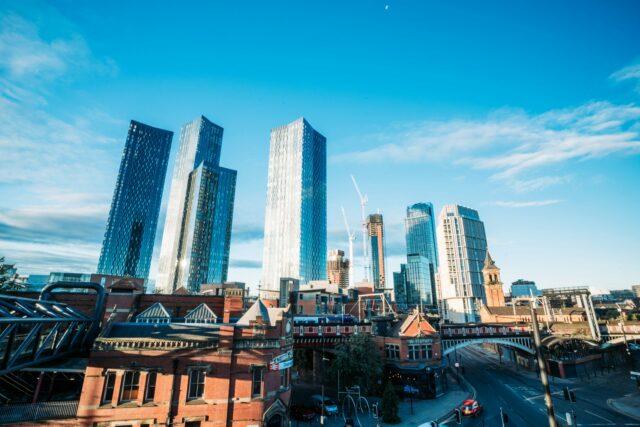
I first noticed it one autumn afternoon when I walked out of Piccadilly station and saw the glass towers of Spinningfields catching the pale sun like a promise rather than a skyline. At that moment it became clear that Manchester was no longer just the old industrial town I remembered from school geography lessons. It had become something else, something quietly assertive, a place where lawyers in tailored coats and bankers with cropped coffees flowed in equal measure.
In the early years of this century, Manchester’s professional services sector seemed almost peripheral. London was the undisputed magnet for legal and financial talent and the buzzing tech start-ups outside the capital were a fringe conversation. But over the past decade that narrative has been overturned as Manchester carved its own identity not as a lesser replica of the capital but as a substantive destination. You can track that shift through the city’s numbers: the combined financial, professional and business services sector here now employs hundreds of thousands and forms a material share of the regional economy .
There are obvious structural reasons for this rise. Manchester’s central location in the UK makes it accessible, its rail and air links stretch out in every direction, tying it firmly into national and international networks. But the more interesting part of the story is how a cluster effect has taken shape over time. The early seeds were sown in places like Spinningfields, where big banks and consultancies first took speculative office space and found a culture worth staying for. From BNY Mellon to Barclays and Deloitte, firms once reticent about setting up outside London are now entrenched in the city’s professional landscape .
The legal sector in particular tells an understated but convincing story of transformation. Once, many law firms saw the North West merely as a region to be serviced from London or Birmingham. Now national and international firms have opened or expanded in Manchester with a seriousness that goes beyond convenience. They recognise that Manchester’s economy has diversified significantly, with vibrant technology, healthcare, finance, and manufacturing sectors that produce consistent demand for sophisticated legal work . You need only sit in a café near one of the larger firms to hear snippets of discussion on intellectual property, data protection, mergers and acquisitions and regulatory compliance as clients pass through its revolving doors.
It is tempting to reduce this to cost arbitrage, and cost certainly plays a role. Office rents and the cost of living remain substantially lower here than in the capital, giving firms financial breathing room and employees a more balanced lifestyle. But that explanation misses the larger cultural shift. Manchester doesn’t just offer cheaper real estate, it offers depth of talent. With five major universities feeding into the local labour market and a strong retention of graduates, there’s a steady pipeline of skilled professionals — not only in law and finance but across tech and business services too .
There are evenings I think about how strange it felt to attend a legal networking event five years ago and see one or two firms represented. Now the same room hums with a dozen firms, young lawyers in sharp shoes leaning in to listen as much as they speak. The demand is real and relentless, especially for lawyers with niche expertise in tech, intellectual property, and data regulatory issues that mirror Manchester’s wider economic contours. That combination — a diverse industrial base and a professional sector nimble enough to serve it — is rare outside the capital.
What has crystallised in Manchester is not a duplicate of London’s financial district but something with its own character. Spinningfields is part of this, yes, but so is the culture of cooperation between local government, university institutions and business networks. The Greater Manchester Combined Authority and inward investment bodies actively shape policies that support skills development, infrastructure and business attraction — factors that large employers watch closely when deciding where to plant roots. The presence of these ecosystem actors creates a sense of direction that many firms describe as a welcome counterpoint to the sometimes bewildering churn of London’s marketplace .
The city has also been willing to embrace newer subsectors as they have emerged. Green finance, for instance, is not yet a household phrase but within Manchester it has become a locus of innovation and growth, with specialised workstreams and banking partners involved in sustainability-linked financing and net-zero initiatives. Such niches exhibit how the city is not just following trends but shaping them in ways that feed back into demand for local professional expertise .
I remember talking to a mid-level associate at one firm who had been here since graduation. She spoke about Manchester not as a stepping stone or second choice but as a place she intended to build a lifetime career. Her tone surprised me. That sentiment was contagious. You could hear it again and again, not just from lawyers but from finance professionals, consultants, accountants, and tech specialists who find the city’s rhythm both grounded and ambitious.
And ambition is precisely the word. Manchester has ambitions to contribute meaningfully to national economic trends while maintaining an identity rooted in the North’s historical resilience and cultural dynamism. It is not a satellite market but a node in its own right, connected to global flows yet anchored in its local community and workforce.
This is what makes Manchester’s professional services evolution feel so genuine. It is not an overnight pivot or a programmed slogan. It is grounded in years of institutional shifts, investments in infrastructure and talent, and a willingness from traditional power players to reconsider the geography of opportunity. The city is not chasing London but charting a course that draws businesses not because they must, but because they see something they can contribute to and benefit from.