


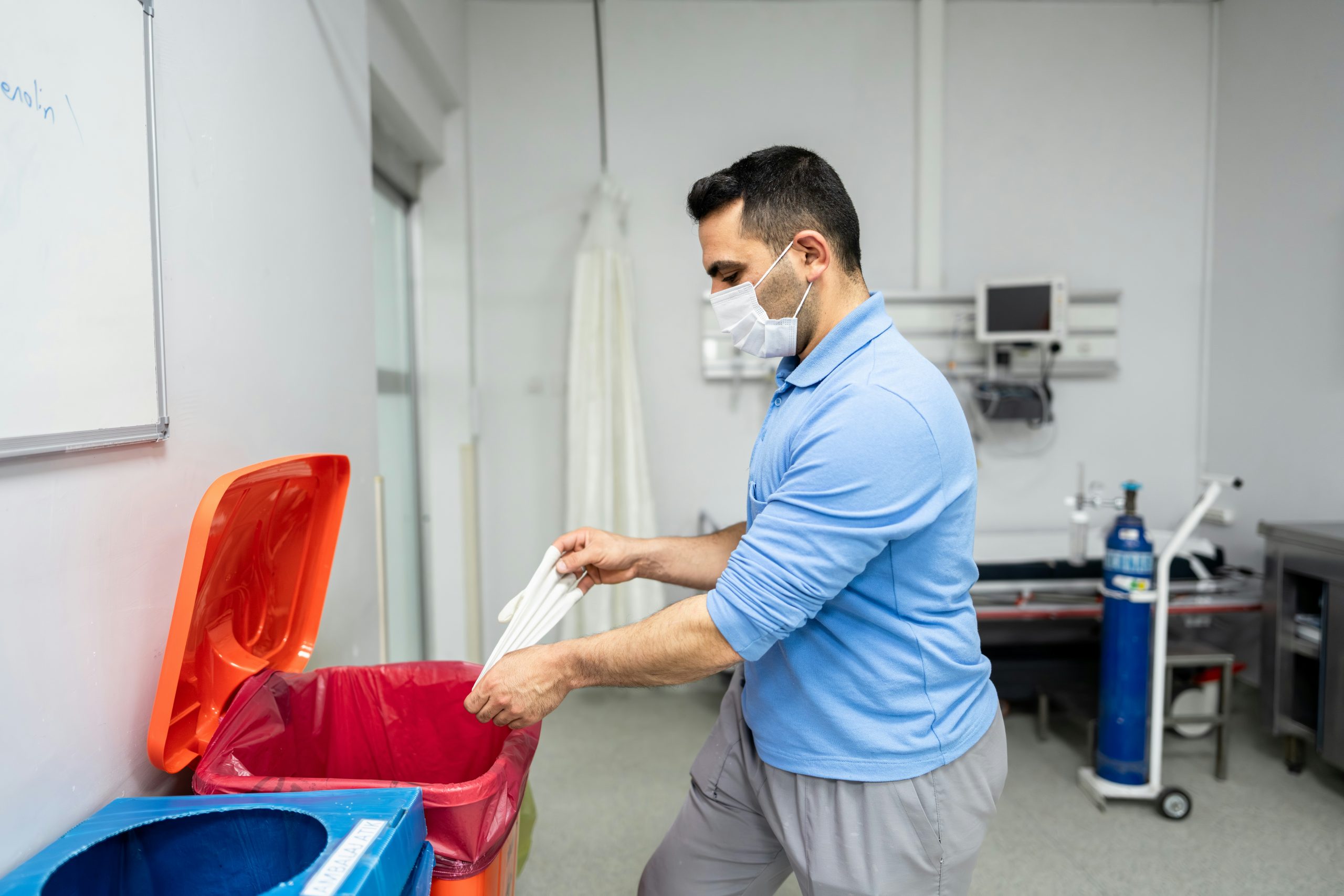
Healthcare administrators and operations managers are required to ensure the safety of their staff and patients. In addition to managing daily operations, one of their core responsibilities is efficient clinical waste management. They are obliged to manage and dispose of clinical waste in compliance with the law. Non-compliance can lead to legal issues, including heavy fines and prosecution. Since clinical waste includes hazardous waste, it must be properly managed; otherwise, it can pose health and safety risks to staff, patients, and the environment.
NHS providers produce around 156,000 tonnes of clinical waste, which is equivalent to over 400 loaded jumbo jets of waste.
Staff training is one of the major components of healthcare operations. Your staff must be trained on how to handle biohazardous materials, sharps, pharmaceuticals, and general medical waste. Designing a detailed waste management training program is critical for safe operations and compliance.
Clinical Waste Regulations: The Best Practices
For healthcare administrators, it is imperative to understand the law around clinical waste management. In the UK, waste regulations vary by area. While designing a training program, you must consider the legal context applicable in your region.
Your staff training programme on clinical waste management must include waste types, colour-coding, waste-transfer documentation, producer obligations, correct waste carriers and permitted treatment options. Additionally, the plan should also reflect the organisation’s internal waste management policy.
The HSE lays down the management of healthcare waste, highlighting infection-control, health & safety, and environmental and transport legislation, while Health Technical Memorandum 07-01 (HTM 07-01) from NHS England sets rules for the safe and sustainable management of healthcare waste. The Environment Act 2021 and the Control of Substances Hazardous to Health Regulations 2002 provide a framework context for environmental protection and hazardous substance control.
A Step-by Step Guide to Designing a Clinical Waste Management Training Program
To develop a training plan for your staff, here is a step-by-step guide that can help you prepare a plan that is sustainable and compliant:
Step 1: Start with Waste-Management Needs Assessment
The first thing to do is to understand the waste management needs of your facility. You can start by identifying the waste streams. What waste types do you produce? It may include waste types such as sharps, chemical waste, infectious clinical waste, pharmaceutical waste, general waste etc. Correct classification and segregation at source is critical according to the waste management law.
It is also essential for you to determine staff roles and exposure levels. Staff members, including nurses, doctors, lab technicians, porters, etc., may have different roles and risk levels.
Be clear about the existing compliance status and review audit findings. Besides, you need to know about the training history and gaps, as this will help you determine whether your staff are trained on the waste management policy, colour-coding, documentation, etc. Also, check whether containers are placed in the appropriate areas and waste is stored correctly. Check whether your staff already ensure complete documentation, including transfer notes and consignment notes.
Assessing all these aspects will help you come up with a tailored plan which is designed on the current requirements of your clinical team.
Step 2: Set Goals & Learning Outcomes
Your staff training plan must include measurable objectives. Setting clear goals will help you know the effectiveness of a training program. For example, you can set objectives such as:
- Your team understand and can identify the different waste streams.
- They should be able to determine risks
- Staff apply segregation protocols with the help of proper colour coding and labelling
- They are well-versed in safe handling, storage and transport procedures
- They should be trained to handle incident/spill situations and be familiar with PPE
Step 3: Develop a Curriculum
Your training program must include a modular curriculum. Here are some modules that you can include in your clinical waste handling training program:
- Introduction to Healthcare Waste
- Regulatory and Organisational Aspects
- Handling, Storage and Internal Transport
- Waste Classification, Segregation and Colour Coding
- Pharmaceuticals, Chemical and Sharps Waste
- Incident Response
- Documentation
- Sustainability
Step 4: Choose Best Training Methods
For effectively training your staff, you must use the most effective training methods. The best approach is to use a number of methods such as face-to-face instruction, e-learning, audio-visual aids etc. Here are some methods that provide you with the desired results:
- Face‐to‐face instructor sessions
- Quizzes
- Hands‐on practical elements
- E-learning modules
- Visual aids
- Refresher sessions
Step 5: Track Implementation
As an administration manager, the next thing to do after training your staff on clinical waste management is to guarantee implementation, which calls for proper scheduling and administration.
You need to ensure that all new staff, including clinical, laboratory and waste-handling workers, complete the main waste-management training before they start working. Refresher programs are essential for ensuring that the staff stays updated with regular changes and new policies.
Record keeping is also important for every training session. It will help in auditing and compliance as well.
Step 6: Evaluate & Make Necessary Changes
Evaluation is an indispensable part of every training program. You can conduct spot audits or observations in clinical areas. It will help you find out if your team is implementing what they learnt. You should check whether staff are using the appropriate containers, applying segregation, and using PPE, etc. Post-training quizzes and practical assessments are also critical to assess knowledge retention. You will also be able to identify modules that may require reinforcement. Taking feedback from participants is also helpful. You can ask your staff what areas were not clear or what they found helpful. All these steps will help you come up with improved programs in future.
Clinical Waste Management Training: Ensuring Compliance, Safety & Efficiency
For UK healthcare administrators, a clinical waste management training program which is compliant has several benefits. It will not only help your staff and patients stay safe but also avoid legal complications.
Understanding the law, assessing your facility’s needs, setting clear goals, developing a compliant training session, and evaluating outcomes are the best approaches to achieving operational, financial, and legal benefits.
The more trained your staff is, the better they can perform. It will also reduce risk to patients and staff and improve overall efficiency. Being vigilant in designing your training programs and ensuring their implementation can help you contribute to society by reducing your environmental footprint. All in all, a well-designed, compliant clinical waste training program is key to ensuring safety and efficiency. A well-trained staff will help you avoid legal complications as there will be fewer incidents, cutting undue costs and risks for your organisation and the community.