


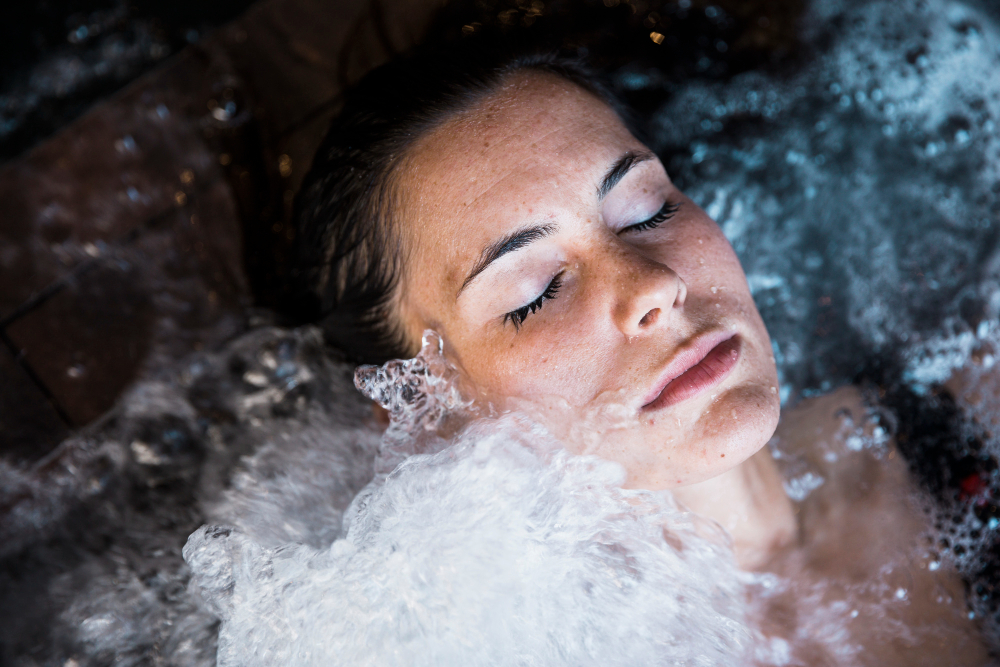
The bath appears oddly commonplace in a calm therapy room within a southern England NHS mental health facility. Porcelain in white. Handles made of stainless steel. It doesn’t seem controversial at all. The only clue is the temperature. A nurse uses a thermometer to check the water, which is just above freezing with faint ripples forming, in anticipation of a session that would have been unimaginable just a short time ago.
Ice baths might have never really gone away. They just moved—from mental hospitals decades ago to prestigious athletic facilities, and now, surprisingly, back again.
| Category | Details |
|---|---|
| Healthcare System | National Health Service |
| Intervention | Cold-water immersion / ice baths |
| Primary Use | Supplementary therapy for anxiety, depression, PTSD |
| Supporting Programs | Chill Therapy CIC, Outside-2 research project |
| Scientific Basis | Linked to norepinephrine release, vagus nerve activation |
| Clinical Context | Used alongside CBT and Dialectical Behaviour Therapy |
| Safety Status | Complementary, supervised, not a standalone treatment |
| Reference | https://www.nhs.uk |
In some NHS-affiliated mental health programs, cold water immersion is being gradually reinstated as therapy rather than as a form of punishment or spectacle. The change is a reflection of a more profound trend within the mental health system in Britain, where doctors are looking for non-pharmacological treatments due to a lack of resources and growing demand.
The anticipation is frequently the first thing that patients notice. After sitting by the tub for a few minutes, a young man who was recuperating from extreme anxiety stepped in, breathing slowly and holding onto the tub’s edge with his hands. The staff did not hurry him. It was difficult to ignore the symbolic significance of the moment as he watched from the corner of the room, as though he were entering something bigger than water.
An instantaneous cascade occurs within the body upon exposure to cold. The heart rate increases. Breathing becomes more rapid. Sometimes there is a sharp rise in neurotransmitters, such as norepinephrine. According to researchers, this flood may provide relief that traditional therapies can take weeks to produce by momentarily improving mood and attention span. However, the experience is anything but cozy.
Some patients, taken aback by their own fortitude, come out laughing. After that, others sit quietly, wrapped in towels, their eyes unfocused, as though they are processing something that is hard to put into words. According to the staff, the emotional response is just as important as the biological one.
The durability of the benefits is still unknown.
Experimental efforts at the grassroots level contributed to the current NHS’s interest in cold therapy. During the pandemic, organizations such as Chill Therapy CIC started bringing NHS employees and patients into chilly sea water in Devon. In addition to improved mood and decreased burnout, participants also reported feeling more confident about their capacity to tolerate discomfort, which is more difficult to quantify.
The true intervention might be that change in thinking.
Medication and talking therapies have long been used in mental health treatment; both are useful but have flaws. Waiting lists are months long. Some patients completely stop participating. Immersion in cold water provides an alternative: immediacy. It requires being there.
Simpler versions are already common in inpatient wards. In dialectical behavior therapy, splashing cold water on the face is a common distress-tolerance technique used to calm emotional escalation and activate the vagus nerve. This idea is furthered by ice baths, which submerge the entire nervous system.
It is still up for debate if that escalation is beneficial.
Critics fear unforeseen repercussions. Blood pressure can rise as a result of cold shock. In susceptible people, it can cause panic. It might cause harm if not closely watched.
Physicians are aware of the dangers.
Ice baths should never be used alone, they stress. They coexist with medication, cognitive therapy, and close observation. More instrument than remedy. The symbolism is still present, though.
The relationship between cold and mental health care is complex. The use of cold baths as a form of coercion in the early 20th century has left a lasting impression. Although the current version feels different—voluntary and collaborative—perception is complicated by memory. Patients also know that history.
One woman talked about how her first immersion was frightening at first, but then surprisingly empowering. She claimed that the cold brought her back to the present and broke the pattern of intrusive thoughts that had ruled her days.
It wasn’t pleasant, she said. She called it enlightening.
Cold therapy seems to be in line with a larger cultural movement. Athletes, executives, and even social media influencers looking to build resilience have started taking ice baths. The NHS seems to be assessing whether that resilience translates clinically, despite their tendency to be slower to adopt trends.
Science provides cautious hope.
According to studies, cold immersion may lessen depression-related inflammation. It might have an impact on the brain networks that control emotions. Often, participants report feeling, at least momentarily, more capable and alert. But there is uncertainty in science as well.
Long-term consequences are still unknown. Benefits differ greatly. Some patients experience no sensation at all.
The bath inside the ward is left to dry under fluorescent lights while the water is drained in between sessions. It appears innocuous once more. However, it feels charged in some way.
It is rare for mental health treatment to result in noticeable changes. Usually, progress is internal, slow, and invisible. In contrast, ice baths force people to confront their discomfort, their fear, and their bodies right away.
Maybe the point is that confrontation.
Or maybe it’s just another experiment, another try in a system that still has questions.