


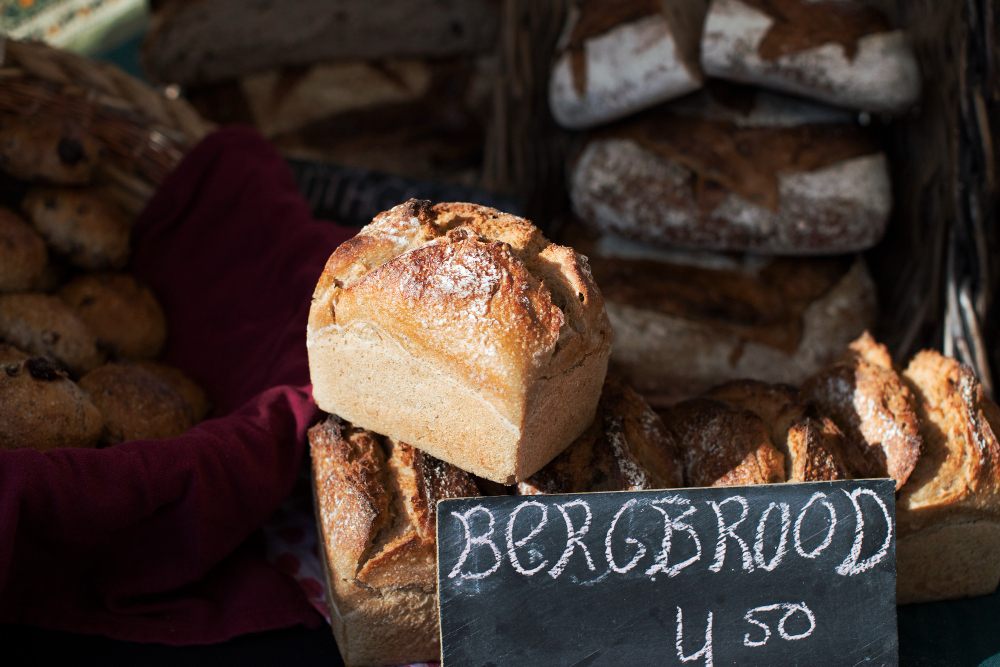
The first signs of the market appeared on a chilly Saturday morning in Bath before the stalls were visible. The warm, tangy aroma of slow-fermented bread wafted through the winding streets, indicating that something both familiar and surprisingly novel was about to happen.
By mid-morning, the square was crowded with wooden tables, each holding loaves whose crusts cracked slightly in the pale winter sun. The tables’ meticulously patterned surfaces bore the marks of hours of skillful preparation, which felt especially novel in a time when speed was everything.
| Category | Details |
|---|---|
| Event | Launch of a street market dedicated entirely to sourdough bread |
| Location | Bath, Somerset, United Kingdom |
| Concept | Every vendor sells sourdough loaves or sourdough-based foods only |
| Typical Price | Most loaves range from £4 to £7 |
| Purpose | Supporting independent bakers and traditional fermentation methods |
| Public Reaction | Strong support from artisan food advocates, but criticism from some residents |
| Cultural Context | Britain continues to debate bread affordability and food inequality |
| Industry Reality | Craft bakeries produce a small minority of bread compared with industrial producers |
| Key Question | Whether artisan food spaces can remain inclusive while preserving quality |
| Broader Meaning | Reflects shifting attitudes toward tradition, value, and community |
Regular visitors found the scene to be remarkably similar to other artisan markets, but one particular detail stood out with remarkable clarity: all of the stalls sold only sourdough, making for a concentrated experience that was both incredibly effective and subtly provocative.
By carefully organizing the event, the organizers were able to create a venue that honored one of the oldest baking techniques in Britain and brought fermentation techniques back into the spotlight, which had been greatly diminished over the previous fifty years due to industrial shortcuts.
In the last ten years, sourdough has seen a significant improvement in its reputation, going from a specialized interest to a widely recognized symbol of skill, thanks to bakers who were reviving long-disregarded customs that are now seen as incredibly successful in creating richer flavor and texture.
In remarkably straightforward terms, a baker at one stall described how natural yeast cultures turned basic flour and water into something more robust, more flavorful, and, she said, more honest.
In a time when many food products arrive without a backstory, her explanation attracted a small crowd of people who listened intently and nodded curiously. This felt especially helpful for bolstering appreciation of skilled labor.
However, not all of the reactions were straightforward.
A retired teacher stood close by, looking at a handwritten sign advertising a six-pound loaf, and while he spoke calmly, his hesitancy revealed worries that felt remarkably similar to discussions about access and affordability taking place all over Britain.
For him, bread was not a product that needed justification or financial calculations, but rather evoked memories of simplicity, something dependable and extremely reliable.
However, a younger couple a short distance away bought two loaves without hesitation, praising the bread for being surprisingly reasonably priced considering its quality. This illustrates how value frequently varies depending on viewpoint, life experiences, and individual priorities.
By combining these disparate points of view in one physical location, the market transformed from a place to shop into a dynamic dialogue that emphasized the expanding relationship between tradition, economics, and identity.
The organizers hoped to strengthen local food systems by strategically collaborating with independent bakers, generating opportunities that were especially creative for supporting small businesses in a more competitive environment.
Their strategy for drawing attention was incredibly successful.
By midday, the square was alive with activity, with people carrying curiosity, opinions, or quiet uncertainty from one stall to another as conversations overlapped and spread out in patterns remarkably similar to a bee swarm.
The market’s rhythm was particularly captivating.
People stopped longer than they usually did.
They had more inquiries.
They paid attention.
In a culture that frequently prioritizes speed over comprehension, this slower tempo felt especially helpful in promoting introspection.
As a result of these exchanges, sourdough evolved from bread to a bridge that united farmers, bakers, and consumers, reestablishing connections that had been severely weakened by anonymous supply chains.
According to one baker, the process was both extremely taxing and incredibly fulfilling because he had to get up before the sun came up every day to tend to dough that behaved erratically and required intuition rather than rigorous control.
As she spoke, her hands were constantly moving, rearranging loaves, brushing away flour, and carrying out minor tasks that demonstrated a quiet confidence cultivated over years of practice.
As I observed her work, it became abundantly evident that sourdough was more than just a product—it was a symbol of dedication.
That dedication was motivating to a lot of supporters.
They thought the market showed that even though technology was changing almost every part of daily life, traditional skills could still be useful.
They contended that communities could embrace progress and preserve continuity by adhering to these customs.
But critics also brought up equally significant issues.
They questioned whether emphasizing only artisan goods ran the risk of alienating those with already tight budgets and making the spaces seem inadvertently exclusive.
They had no hostile concerns.
They were considerate.
Instead of showing resistance, they showed a desire for inclusion.
The market’s organizers started looking into solutions to those issues through constant communication, bringing up ideas like shared buying schemes, smaller loaves, and educational seminars aimed at lowering the barrier to entry for sourdough.
These concepts, which implied that accessibility and tradition did not have to conflict, felt especially novel.
Rather, they could co-evolve.
Conversations slowed, vendors leaned back for a moment, and the market’s previously intense atmosphere gave way to quiet satisfaction as the afternoon light softened.
A child ran by with a loaf almost as big as her arm, laughing, and her parent followed, grinning in a way that seemed to be understood by everyone.
Such moments suggested a hopeful future.
With perseverance and teamwork, the market had developed into more than just a location to purchase bread; it had become a gathering place for people to share a common interest that was both age-old and modern.
It might have an impact outside of Bath in the years to come.
The market provides a model that could be especially helpful for communities looking to strike a balance between tradition and modern life by showing how traditional skills can continue to be economically viable.
It is still a modest but effective experiment for the time being.
subtly influencing discussions.
building comprehension gradually.
Perhaps most importantly, it serves as a reminder that even the most basic foods can tell tales that are worth keeping alive.