


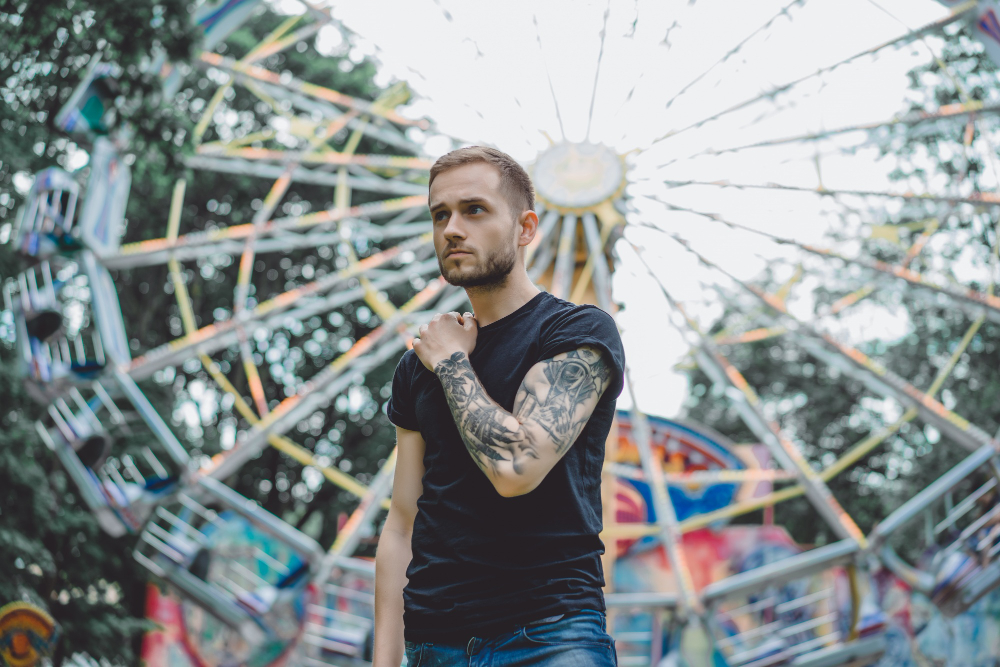
A man rolls up his sleeve and smiles with a look of pride on a wet afternoon near Brighton station, inside a small tattoo parlor that smells slightly of antiseptic and sea salt wafting in from the Channel. A familiar face, slightly intense, with eyes fixed somewhere beyond the horizon, is inked across his forearm. Roberto De Zerbi, frozen in the middle of a cry.
Perhaps this kind of football devotion has always existed, but in this instance it feels remarkably intimate, almost religiously devotional.
| Category | Details |
|---|---|
| Full Name | Roberto De Zerbi |
| Born | June 6, 1979, Brescia, Italy |
| Profession | Football Manager |
| Brighton Tenure | 2022–2024 |
| Major Achievement | Led Brighton to first-ever European qualification |
| Known For | Emotional coaching style, attacking football |
| Cultural Impact | Inspired murals, tattoos, and widespread fan devotion |
| Current Role | Manager of Olympique de Marseille |
| Reference | https://www.premierleague.com/managers |
The fan discusses the tattoo as a memory rather than as ornamentation, revealing only his first name, Callum. He recalls the match in Marseille. The late goal. Like he had lost control of his own body, De Zerbi leaped into the crowd. “It felt like something inside the club had changed permanently, replacing years of cautious hope with something louder and harder to ignore,” Callum said as he watched from the North Stand.
De Zerbi seemed to have done more than just oversee Brighton. He changed the emotional temperature.
Callum’s arm is just the start. His calf bears the words “There is a God of Football,” which are reminiscent of the now-famous mural that local artist Guy Favela painted in the heart of the city. The imperfect lettering and the way the words curl around his leg muscle somehow lend it a more genuine feel.
On a matchday stroll through Brighton, it’s difficult to ignore how De Zerbi’s influence endures to this day. Five minutes from the station, his face is still fixed on that mural as commuters rush by with headphones and takeout coffee cups. Some look up. Others don’t.
The second tattoo, he claimed, was more painful. Psychologically, not physically. The devotion became irreversible. There was no way out of that situation, no way to later act like De Zerbi was just another manager.
It was Brighton’s first time qualifying for Europe. When you say that fact out loud, it still sounds unlikely.
Older fans occasionally recall the days of Withdean Stadium, when games were held in a temporary stands in an athletics arena that had been converted, and the atmosphere felt brittle. It would be like comparing two completely different clubs to compare that period to De Zerbi’s Brighton.
Whether that transformation can ever be completely replicated is still up in the air.
Following De Zerbi’s farewell in May 2024, Callum started adding more ink. From the Amex, he observed as the manager took the microphone and thanked the supporters, his voice cracking a little. Strangers embraced one another around him in a manner typically reserved for relatives.
Callum scheduled his third appointment the following morning because of something that happened at that moment.
This time he picked a smaller piece. Just figures. 2023.
That was the year that everything changed.
Of course, football tattoos are not uncommon. They are owned by players. They belong to fans. De Zerbi himself wears ink that is connected to Brescia, his hometown, signifying allegiances that go beyond work agreements. However, the level of emotional investment feels different here.
This had nothing to do with nostalgia. It had to do with preservation.
At first, Callum’s friends made fun of him by asking what would happen if De Zerbi failed somewhere else or faded into obscurity. He gave a shrug. It made no difference. The significance was independent of future achievement.
After winning a group that included Ajax and Marseille, Brighton’s European campaign gave fans something material to cling to. The club shared a stage with giants for a while.
There is a hint of melancholy in the air as you stroll along the waterfront now, past arcades and fish-and-chip stores that close early in the winter. It feels quieter now.
Callum acknowledges that he occasionally questions whether he went too far. Not exactly out of regret. More in acknowledgment of the rarity of that emotional peak.
Supervisors depart. Players go on. Permanence is rarely permitted in football.
He discusses De Zerbi as a person rather than as a tactician. The pace of the touchline. The yelling. The times when he appeared more like a fan who had inadvertently wandered onto the field than an employee.
That genuineness was important.
Despite its recent success, Brighton has always felt a little bit like an outsider club. fashionable, well-liked, but not conventionally strong. Instead of attempting to change the club’s identity, De Zerbi appeared to understand it intuitively and leaned into it.
Fans reacted appropriately.
In 2024, tattoos were even brought up at a forum for supporters. At first, it sounded ridiculous, but it had a deeper meaning. The club’s cultural lexicon now included tattoos as a gauge of emotional commitment.
It’s difficult to ignore how football blurs the boundaries between belief and entertainment as you watch this play out.
Callum claims to be done. No more ink. Most likely.
He says it with a smile, though, which casts doubt on the assertion.
He still occasionally stops by the mural, standing silently for a few seconds before continuing. The majority of passersby don’t know who he is or what ink is concealed under his jacket.