


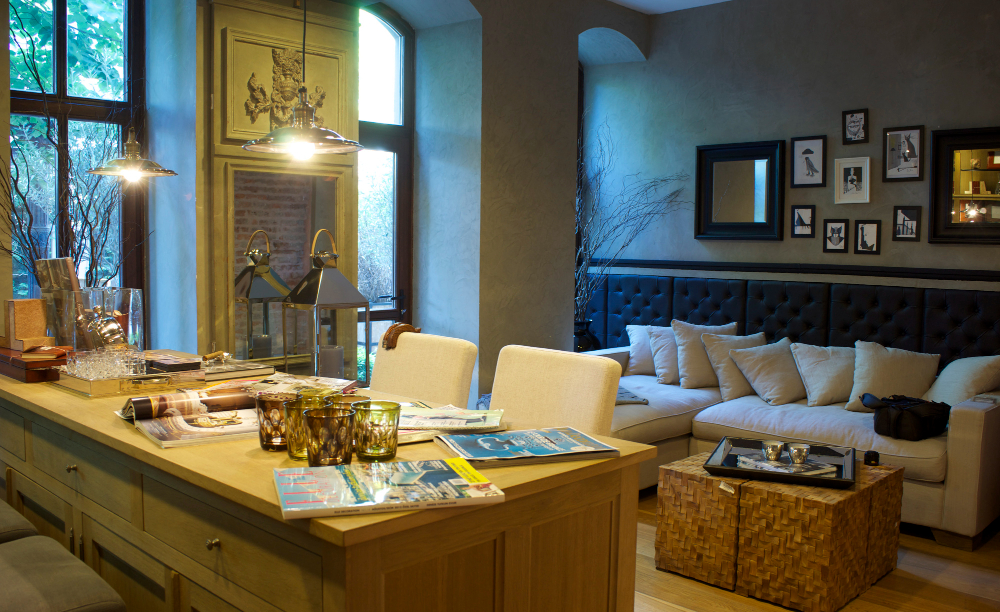
“Can you design my entire apartment?” was the initial query entered into a chat window along with a blank floorplan. With artificial intelligence serving as the only guide, a one-bedroom apartment in East London was transformed into a silent test of innovative delegation.
The owner, a self-taught programmer with no design experience, chose to delegate all layout and aesthetic choices to ChatGPT. His objective was to determine the extent to which trust in language models could permeate physical space, not to automate out of laziness. He turned a bland 51-square-meter rental into a noticeably elegant and individualized residence by working with ChatGPT every day.
| Item | Detail |
|---|---|
| Location | East London (exact address withheld) |
| Completed | Late 2025 |
| Designed By | ChatGPT (via AI prompts and human execution) |
| Budget | Estimated £42,000 including labor and materials |
| Key Features | AI-led layout, color schemes, furnishings, and lighting |
| Reveal Status | Documented anonymously online; exhibit planned for 2026 |
He began by uploading floor plans and outlining the restrictions, which included low-gloss finishes, natural light coming from the east, no structural alterations, and a mid-range budget. In response, the model offered choices for lighting angles, paint jobs, and flooring. The conversation became surprisingly fluid over time.
The color suggestions were especially accurate: moss green for warmth, with accent walls that were sand-toned and walnut furniture that had matte brass accents. The palette seemed intuitively correct to someone who had never been fond of moodboards.
Quick changes also occurred in material suggestions. The model suggested combinations that were both fashionable and useful by utilizing spatial data and previous conversations. In damp areas, porcelain tile is placed over engineered oak. To cut down on maintenance, microcement countertops. A small storage unit that looks like a bench and can be used as seating for dinner guests.
The owner used questions and prompts to refine concepts verbally rather than depending on visual aids. This extremely effective method greatly decreased planning fatigue while opening up opportunities that a more conventional approach might have overlooked.
Some of the outcomes were amusing. Inspired by Mondrian layouts, the AI recommended an asymmetrical bookshelf with soft LED uplighting to prevent shadows. A ceiling-mounted mirror with gentle perimeter lighting that is “diffused enough to flatter without deception” was suggested for the bathroom. Despite his laughter, he went ahead. It functions.
The apartment doesn’t seem mechanical or futuristic. It’s soft. carefully weighed. visually consistent but also subtly tense—a combination that frequently calls for careful selection. Nevertheless, it originated from a machine in this instance.
About halfway through, he made a startling admission. “I did more than save time. I didn’t compromise as much. I followed what felt interesting, and it was freeing to not have to worry about being “tasteful.”
I remembered that moment. the choice to substitute curiosity for hesitancy, driven by flexible, responsive discourse rather than by fads or influential people.
For the construction, he collaborated with a contractor but never engaged an interior designer. Spatial logic and concepts were covered by the AI. Installation and measurement were done by the contractor. Although it was a lean process, it was very successful. Timelines were strict, materials were obtained locally, and the finished product was within budget.
Online, the completed apartment has received little attention. The change is now monitored by the anonymous Instagram account @flat51ai, which pairs each post with the initial prompt that prompted it. The arched hallway light in one picture is said to be “reminiscent of candlelight but with cooler undertones.” Another displays a low coffee table with a Japanese aesthetic that was chosen in response to a question concerning items that “create visual pause without blocking flow.”
The prompts are all strangely poetic. Every result seems rooted in its purpose.
The proprietor discovered during this process that ChatGPT could be a very flexible creative partner, especially helpful for early ideation, problem-solving, and gaining stylistic confidence. Over time, what started out as a technological curiosity evolved into a cooperative practice.
Next spring, a pop-up exhibition is being discussed, which might let guests explore the apartment while reading the AI-generated design dialogue displayed on suspended panels. The apartment itself is already a powerful illustration of what AI-assisted living could look like—not someday, but now—regardless of whether or not that materializes.
Text-to-design workflows have been the subject of more open experimentation in recent months by both designers and homeowners. For layout consultation, some people use ChatGPT. Others make extremely specialized moodboards by combining it with visual tools such as Midjourney. Boundaries are changing.
However, this apartment goes one step further. AI isn’t the only source of inspiration. It views the model as a conversational, reasonably intuitive, and, in this instance, surprisingly economical active decision-maker.
There were difficulties in the process. Some of the prompts generated ideas that were too ambitious or unrealistic. A floor plan that miscalculated appliance clearance and a lamp recommendation that was incompatible with UK voltage were among the near-mistakes. However, those moments were swiftly captured, typically with a straightforward cross-check. They didn’t compromise the overall procedure.
Friends who have visited the apartment since it was finished have responded with a mixture of awe and incredulity. Many believe there must have been a designer involved. Others inquire as to where they can find the same bench, the same subdued wall lights, and the same feeling of serenity. Naturally, the irony is that there is no catalog that contains the precise answers. They emerged from a conversation. out of context. by choice.
The most uplifting aspect? It doesn’t feel sterile at all. Even though an AI controlled the apartment, human reaction ultimately shaped it. inclinations. Edits: Quiet decisions made in the background.
More people will try this process in the years to come. AI can change how creativity is accessed, not because it will replace it. It provides a starting point for people who are overwhelmed by options and a voice to those who lack the appropriate vocabulary. Intentional use turns it into a very powerful co-pilot for creative thought.
Today, the East London secret apartment is a viable theory. What happens if we start asking better questions, one prompt at a time, instead of designing by default?
It is a flat that responds with rhythm rather than revolution. And that seems especially encouraging.